Showing posts with label Jewish. Show all posts

Sunday, February 24, 2013

Leonard Cohen As Irreverent Master of Prayer


Can You Hear My Song? Leonard Cohen as Irreverent Master of Prayer
By Shefa Siegel
March 2013, Sojourners Magazine

IF YOU ARE not overly familiar with the repertoire of a Leonard Cohen concert, it's hard to tell the new songs from the old. Songs from a different age sound neither anachronistic nor nostalgic, while the new echo as though they have been around forever. It's the same show night after night, with songs from the latest album, Old Ideas (released in 2012), woven into the familiar canon. Cohen tells audiences that his revivalist tour might end in two years, so that he can start smoking again by the time he turns 80.
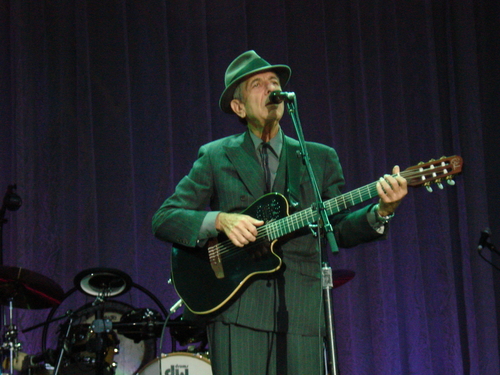


    It is a joke you know Cohen has cracked a hundred times, the kind that makes my brother call him the Jewish Dean Martin. The humor is one part of a precise choreography, whose arrangements shift from blues to waltzes to New Orleans jazz, Celtic, gospel, country, and disco, all set in the mode of Hebrew Minor and conspiring to create a vivid world that does not exist, except in paradox. Honey is the texture that comes to mind. Viscous and turbid, neither solid nor liquid. Sensual relief from the coarse, metallic world. And sweet. Sweet in the meaning of the verse from the Persian song "Navaee"—"High sweet melody, and sadness of love, dwelling in the bottom of the heart, where nobody sees"—the mixing of sorrow and transcendence into sublime paradox.
    He is and has been many things to his devotees: poet, singer, writer, band leader, lover, satirist, artist, and novelist. But one thing Leonard Cohen is not is a preacher.
    Prostrating and posing on bended knee, eyes knit tight, hat pulled low—he could say anything he pleases, from treatises to treason, and people would listen. Given a room and a crowd, the born preachers cannot tame the urge to climb atop the pulpit. This political instinct to prophesy and govern is noted but subdued in the opening song of Old Ideas, called "Going Home," the cry of an old man liberated from burdens of desire for love and for mission: "He will speak these words of wisdom / like a sage, a man of vision / though he knows he's really nothing / but the brief elaboration of a tube ... a lazy bastard living in a suit."
    Although he is no preacher, to say that the poems of Leonard Cohen have a liturgical quality is no stretch. He has played with Jewish canonical formulas for decades. "Who by Fire" revises one of the central liturgical themes of the autumnal atonement festivals (Rosh Hashana and Yom Kippur). "If It Be Your Will" uses a call-and-response technique through which priests and prayer-leaders communicate with congregants during worship.
    But more than any mimicry of liturgical methods, there is a theological consistency in the language that evokes an essential tension guiding the approach Hebrew liturgy uses to converse with God. I like to watch the faces and postures of people at a Leonard Cohen concert: This one has her hands folded beneath her chin, that one his eyes closed in reverie, others are rocking their shoulders back and forth—shucklers, petitioners, prostrators, mumblers, and practitioners crooning in naked prayer.
    Few words are more degraded and deadening than "prayer." There is something uniquely uncool about it. No New York publishing house would be excited by an author submitting a book of prayers. The word and the actions it represents seem static and boring. Hebrew liturgy, however, has no single term for prayer: The varieties of prayer are countless and constantly evolving because any utterance performed with the right approach can become prayer, if one is a "master of prayer."
    The master of prayer ( baal tefillah in Hebrew) is nothing like the rabbinic preacher. Rabbis are controversial. They antagonize congregants, who find every which way to criticize the rabbi. The role of the master of prayer is to hold the community together. Since the objective of prayer is unitive, the master of prayer cannot be divisive. Individual prayer unites the soul and its seeker: communal prayer unites factions by annulling abstractions. The rabbi is a professional: equal parts lecturer, bureaucrat, adjudicator, and administrator; to every ruling there is opposition, every decision offends somebody. The master of prayer is an amateur. A populist. People want the rabbi to be above and better: more pious, reverent, disciplined, and wise. The master of prayer must be irreverent like everyone else, because if the master of prayer has the right to atone—and we know he's a sinner!—then I must also possess the right.
    In the Rosh Hashana liturgy, this right is exercised by speaking truth, singing, trumpeting, bargaining, reminiscing, and even threatening to get angry with God—"Remember that time you made a covenant with Abraham / Don't you forget this deal / Or that it applies to me, no less than Abraham," the liturgy implores.
    The most common misinterpretation of this liturgy is that we are petitioners, and God our absolute king and judge. But the approach is precisely the opposite: Dualism seems so real, but it is illusion. God is majestic and I am nothing, and yet God Majestic is crowned only at the pleasure of my participation. Since everything is God's creation, sin and suffering are neither separation nor exile: God forgives because in the end there is nothing to forgive. The game is rigged, but in my favor.
    "We find ourselves / on different sides / of a line nobody drew," Cohen writes in a new song called "Different Sides." "Though it all may be one in the higher eye / Down here where we live it is two." And elsewhere on the album, the prayer "Come Healing" goes: "O, troubled dust concealing / An undivided love / The heart beneath is teaching / To the broken heart above."
    Still, the master of prayer, despite knowing he possesses the right, approaches the throne of God humbly, just "a lazy bastard living in a suit," as Cohen puts it. "Here I am," is the opening line introducing the atonement ceremonies of Rosh Hashana and Yom Kippur. "I am here even though I am not worthy of offering this prayer."
    This posture of the humble supplicant—"the brief elaboration of a tube"—is rooted in the ecclesiastical concept of vanity (in Hebrew hevel), which refers not to meaninglessness, as it often translated, but transience. "What are we? What are our lives ... When really there is no difference between a human being and an animal, because everything is vanity" (Ecclesiastes 3:19).
    Ecclesiastical humility is the foundation of Hebrew canonical prayer, yet it is set directly alongside the boldest of spiritual concepts. "What gives me authority to stand here and ask for compassion?" the "Here I am" prayer asks in its conclusion. "Nothing, except that masters of prayer are angels, carrying prayers to the throne of God." The paradoxical merging of these two postures—ecclesiastical and angelic—creates the experience of majesty, of holiness, by entangling the worminess of inhabiting the body with the audacity to offer the highest prayer.
    Among the varieties of prayer, this paradoxical prayer is the most demanding to perform. It stretches the imagination farthest, pushes the voice hardest. One must be absolutely sincere, or the whole effort disintegrates, and instead of honey the product is sap. When executed exquisitely, however, it makes angels and unrepentant sinners of everybody present. "You'd sing too," Cohen writes in his 2006 collection of poems, Book of Longing. "You wouldn't worry about / whether you were as good / as Ray Charles or Edith Piaf / You'd sing / You'd sing / not for yourself / but to make a self."
    I don't mean to suggest that Leonard Cohen ought to be viewed only as a Jewish liturgist. How artificial and trivial this sounds! Anyway, you never know for certain when he is singing to the women of his life and when he is singing to God. Yet it's hard not to recognize the humble qualities of a master of prayer, who, when attempting to summon the nerve to sing, can do no more than close his eyes, grab hold of something firm, and hope to hell his voice doesn't crack.
    Shefa Siegel, from Vancouver, British Columbia, writes about environment, ethics, and religion. His essays appear inHaaretz, Ethics & International Affairs, Americas Quarterly, and Yale Environment 360.

    Sunday, May 13, 2012

    The Writing is on the Wall: Messages from Palestine


    I spent two weeks in Palestine during March.  The first half at a peace conference sponsored by Bethlehem Bible College that had over 600 particpants from various realms of the Christian, Jewish, and Islamic faiths, as well as representatives of Palestinian and Israeli governments.  In all, there were people from 21 countries exchanging ideas, discussing, debating, and working on plans for the grwoing peace efforts that are so crucial if this conflict is ever to be resolved.

    The second week of my stay was with a lovely Palestinian Christian family in their home with many daily trips around the occupied territories as well as into Israel.  It was enlightening to see what pressures this family and their neighbors are under from the apatheid state that the Israeli government has put them under.  Over 250,000 brothers and sisters in Christ live in Palestine, alongside close to 3 million Muslims, and their rights have been curtailed, land taken from them, and freedom of movement strongly discouraged. The prime example of the latter is the ever-growing "security wall" that is three stories tall and stretches hundreds of miles to seprarate the territories.  In many cases, homes and businesses have been destroyed to make way for the barrier, and excesses have been demonstrated by the Israeli government taking over thousands of additonal square miles beyond aggeed-to borders for thier own gain.  Additonally, the checkpoints allowing Palestinians to enter Israel, or to re-enter their own occupied state are often overcrowded, and there can be delays of 5 hours just trying to get to their jobs or hospitals, etc.  

    Now don't get me wrong, I believe Israel deserves to live in peaceful security.  I love the Jewish people and want them to have a homeland.  There just needs to be a better system in place than this.  I hope, pray, and believe there will be a day when this wall will come down and there will be peaceful co-existence.  That's one of the reasons I follow "The Prince of Peace."  

    By the way, there is no freedom of expression via painting allowed on the Israeli side of the wall, but I met many Israeli citizens who are disgusted with this severe partition and feel it is has gotten out of control. I was able to walk along the wall on  thePalestinian side for just a few miles, and here are some of the messages I saw expressing views on what has happened, and hopes for a better tomorrow through peaceful reconciliation. Let me know which ones resonate with you:


    Sunday, April 1, 2012

    The Real Holy Sights of Palestine and Israel

    It’s been a week since my return from the Middle East where I took part in a remarkable peace conference as well as spending four days living with a Palestinian Christian family to better understand their challenges.

    People are always curious about what sightseeing I did on my various trips, and certainly the Holy Land is full of remarkable history at nearly every turn. Thousands upon thousands of years of history wash over you as you traverse this rather tiny plot of land where major religions have been spawned, wars have been waged, and kingdoms were built and torn down.

    I walked along the walls surrounding Jerusalem’s Old City that were constructed by the Ottomans, gazed up at David’s Tower, entered Jaffa Gate, and wandered thru the maze of shops that make up much of the Christian Quarter. I climbed the Mount of Olives, saw the Tomb of the Virgin Mary, knelt in the Church of Gethsemane, took in the view of the Temple Mount, drove thru the Valley of Kidron, and even stared into the bowels of Gehenna (yes, THE Gehenna, the former Jerusalem city dump that was used as a metaphor for Hell). I was on the route that Jesus supposedly took on his triumphal entrance into the city on Palm Sunday. I peered into the Damascus Gate, spied Mt. Carmel where Elijah called down Jehovah’s fire upon the Prophets of Baal, saw Herod’s summer retreat built into the cone of a volcano, and visited the Mosque in Hebron that houses the tombs of Abraham, Isaac, and Rebecca.

    While In Jericho, a photographed the sycamore tree that Zacheus climbed, and hiked over the many layers of excavation of the self-proclaimed “World’s Oldest City,” including the walls that came a-tumblin’ down. Above there was the Mount of Temptation where Satan offered Christ the whole world. Along the desolate Pat River gorge I looked down onto St. George’s Monastery that was ingeniously built into the sandstone cliffs, looking like a piece of Rivendell. On the shores of the Dead Sea I visited the Qumran Park where the infamous scrolls of ancient texts were discovered in the caves that pockmark those mountainsides.

    Bethlehem, where I was stationed most of my visit, is certainly chock-full of every imaginable site that has to do Christ’s birth, not the least of which is Manger Square, and the fields where the shepherds were greeted by the heavenly host.

    With nearly every one of these locales there is the seemingly requisite cathedral, synagogue, or mosque (sometimes all three), overrun with tour guides to help you better understand the historical narrative, and a never-ending cadre of souvenir shops filled with the specific bric-a-brac to help memorialize your sojourn there. Upon close inspection, the vast majority of said trinkets were manufactured in China, which tends to diminish the authenticity a tad. Hucksters besieged me in the Christian Quarter as I wound my way through the gauntlet of mercenary consumption (one store was appropriately named “Lord Kitsch”), and wondered if this was not much different than what Jesus fumed about when he threw the moneychangers out of the Temple.

    Besides the rather questionable claims of exact locations of Christ stumbling with the cross on his shoulder or what-have-you, there are the ones that are just blatantly made up. For instance, when traversing past Bedouin encampments along the road between Jerusalem and Jericho, we saw signs proclaiming “Site of the Good Samaritan.” Hmmmm…that was a parable. And yet it was a common destination for many of the Christian tours.

    It got me to thinking that there was some serious shekels to be made if I could come up with my own apocryphal miracle marker. Then it struck me as we were walking the tight streets a block away from Christ’s birthplace that no one had determined exactly where Mary’s water must’ve broken on that special night. Why, with some pseudo archeology and liberal portions of hearsay, I could start declaring that this very spot (conveniently located on a low-rent storefront), is where that glorious gush took place. I could hew out a granite cistern of sorts and fill it with crimson liquid to clearly mark the consecrated puddle. In no time I could construct the Sepulcher of Most Holy Amniotic Plashet and be a quick add-on to the tours of tens of thousands of trusting souls who are bussed in each day to wander about the hallowed nativity grounds. You may think I wax too cynical, but I assure you it is not far from what has been purported as truth in many of these domains.

    But before I could become too skeptical of the big tourism business, I would always be reminded of what was truly holy. It was hard to miss, since there were so many instances of it on display: lovely children populating the cityscapes and countryside. Whether watching Israeli kids all dressed up in whimsical costumes to celebrate Purim, or Palestinian girls wearing their pastel hijab headscarves at a bus stop, or Jewish kindergartners walking hand-in-hand across a busy street on their way to temple, Muslim and Christian Palestinian school children frolicking on a playground...I was struck by the fact that Abraham’s descendents were, indeed fruitful and did multiply. Those seeds now populate three of the largest religions on the planet. And it all started there.

    The simple joys of these little ones kept me going when I was overwhelmed with the crass commercialism, or the sad tales of terrorism and injustice going on. While walking through the market in Hebron, I spotted some precocious five-year old Palestinian girls who became fascinated with my digital camera. As we visited a Muslim home on the West Bank, I was interacting with a ten-year old boy about silly phrases and moves by WWE Wrestling superstars. In Bethlehem I visited with a three- generation trio of a toddler, his dad, and the grandfather. Near Efrata I was surrounded by half a dozen elementary aged Muslims who were joyfully peppering me with questions in broken English and curious about everything American. Our taxi driver for several of the days, Abed, had the most adorable toddler daughter, named Rancon, who would sometimes ride in the cab with us. We were so excited for him as he had just become a father for a second time when his wife gave birth to a healthy young girl while we were there.

    Abeer and Fadi, the mother and father of the Palestinian Lutheran family that we stayed with the final four days, had three amazing kids: the pretty Leena and Gina, and the handsome Hanna. They were doing there best to get along in the land of their forefathers (they come from a church tradition that goes back numerous generations). During our breakfasts and dinners together each day, we learned much about their daily lives, the education of their children and the pride of their extra-curricular school activities. They showed us photos of family milestones, and gave funny accounts of chapters of their familial histories. And we also asked about the hassles of working around a state of occupation.

    For instance, Abeer’s sister was purposely given improper forms to fill out when she crossed the border into Lebanon to attend a business conference, and has not been allowed back in through any of the Israeli checkpoints since , forcing her to take up residence in Beirut. So, for seventeen years, Abeer has not been able to see her sister face-to-face. And Fadi’s brother, tired of taxation by the Israeli government without proper representation, was imprisoned for sixty days back in the early 90s. They seized his home, his furnishings, his store, and the goods of his medical supply business. Pretty steep penalties for just half a year of non-payment. He was finally allowed to go free, but none of his belongings or property was ever returned. We heard story after story like this from many of the Palestinians we met. Even Israeli citizens would shake their heads in shame recounting tales of their government’s overly harsh policies.

    There is an overarching sense of weariness from the adults in that region. 95% of the Palestinians want a peaceful reconciliation, and even 70% of the Israelis agree. But when you look at the kids, whether teens or toddlers, they have hope in their eyes. Maybe it is the naïveté of youth. I’d rather look at it as a spark of the divine in their eyes. No one ever thought there would be peaceful resolutions between the British Empire and India during the 30s and 40s in their search for independence; nobody thought the Apartheid of South Africa would ever be solved without a massive conflict; the hatred in Northern Ireland between the Catholics and Protestants was considered too deep-seeded for coexistence; none of the experts saw the collapse of the Iron Curtain in Eastern Europe without bloodshed; nor did anyone think that Civil Rights would ever take hold in America led by a ragtag group of southern ministers…and yet in all these cases things changed due to non-violent reconciliation, often with the younger generations leading the way.

    So, instead of giving much credence to the oft-dubious sites of supposed religious significance from eons gone by, it’s these young faces in Palestine and Israel that become the holy sights that get me excited about the future of this fascinating land. When I look back on this trip, and close my eyes to pray, they are the ones I see. May I keep that vision before me. May we all.

    You can see some of these “Holy Sights” in my photo collection of the same name on my Facebook page.