Showing posts with label paradox. Show all posts

Sunday, October 27, 2013

Autumn: When death and elegance walk hand in hand


Autumn is a season of great beauty, but it is also a season of decline: the days grow shorter, the light is suffused, and summer’s abundance decays towards winter’s death.  Faced with this inevitable winter, what does nature do in autumn?  It scatters the seeds that will bring new growth in the spring—and scatters them with amazing abandon.

In my own experience of autumn, I am rarely aware that seeds are being planted.  Instead, my mind is on the fact that the green growth of summer is browning and beginning to die.  My delight in the autumn colors is always tinged with melancholy, a sense of impending loss that is only heightened by the beauty all around.  I am drawn down by the prospect of death more then I am lifted by the hope of new life.

But as I explore autumn’s paradox of dying and seeding, I feel the power of the metaphor.  In the autumnal events of my own experience, I am easily fixated on surface appearances—on the decline of meaning, the decay of relationships, the death of work.  And yet if I look more deeply, I may see the myriad possibilities being planted to bear fruit in some season yet to come.

In retrospect, I can see in my own life what I could not see at the time—how the job I lost helped me find work I needed to do, how the “road closed” sign turned me toward terrain I needed to travel, how losses that felt irredeemable forced me to discern meanings I needed to know.  On the surface, it seemed that life was lessening, but silently and lavishly the seeds of new life were always being sown.

This hopeful notion that living is hidden within dying is surely enhanced by the visual glories of autumn.  What artist would ever have painted a season of dying with such a vivid palette if nature had not done it first? Does death posses a beauty that we—who fear death, who find it ugly and obscene—cannot see? How shall we understand autumn’s testimony that death and elegance go hand in hand?

For me, the words that come closest to answering those questions are the words of Thomas Merton: “There is in all visible things a hidden wholeness.”  In the visible world of nature, a great truth is concealed in plain sight: diminishment and beauty, darkness and light, death and life are not opposites.  They are held together in the paradox of “hidden wholeness.”

Autumn constantly reminds me that my daily dyings are necessary precursors to new life.  If I try to “make” a life that defies the diminishments of autumn, the life I end up with will be artificial, at best, and utterly colorless as well.  But when I yield to the endless interplay of living and dying, dying and living, the life I am given will be real and colorful, fruitful and whole. 

Parker J. Palmer from the chapter “There Is a Season” within his book Let Your Life Speak (copyright 2000, John Wiley and Sons, Inc.)

Sunday, February 24, 2013

Leonard Cohen As Irreverent Master of Prayer


Can You Hear My Song? Leonard Cohen as Irreverent Master of Prayer
By Shefa Siegel
March 2013, Sojourners Magazine

IF YOU ARE not overly familiar with the repertoire of a Leonard Cohen concert, it's hard to tell the new songs from the old. Songs from a different age sound neither anachronistic nor nostalgic, while the new echo as though they have been around forever. It's the same show night after night, with songs from the latest album, Old Ideas (released in 2012), woven into the familiar canon. Cohen tells audiences that his revivalist tour might end in two years, so that he can start smoking again by the time he turns 80.


    It is a joke you know Cohen has cracked a hundred times, the kind that makes my brother call him the Jewish Dean Martin. The humor is one part of a precise choreography, whose arrangements shift from blues to waltzes to New Orleans jazz, Celtic, gospel, country, and disco, all set in the mode of Hebrew Minor and conspiring to create a vivid world that does not exist, except in paradox. Honey is the texture that comes to mind. Viscous and turbid, neither solid nor liquid. Sensual relief from the coarse, metallic world. And sweet. Sweet in the meaning of the verse from the Persian song "Navaee"—"High sweet melody, and sadness of love, dwelling in the bottom of the heart, where nobody sees"—the mixing of sorrow and transcendence into sublime paradox.
    He is and has been many things to his devotees: poet, singer, writer, band leader, lover, satirist, artist, and novelist. But one thing Leonard Cohen is not is a preacher.
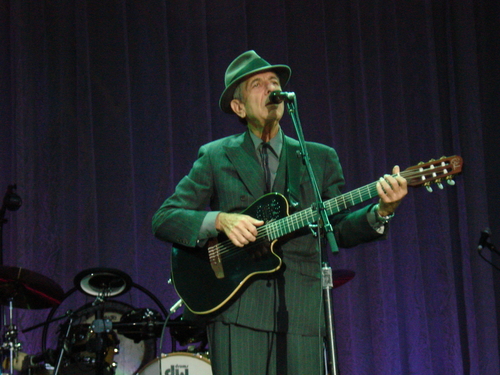
    Prostrating and posing on bended knee, eyes knit tight, hat pulled low—he could say anything he pleases, from treatises to treason, and people would listen. Given a room and a crowd, the born preachers cannot tame the urge to climb atop the pulpit. This political instinct to prophesy and govern is noted but subdued in the opening song of Old Ideas, called "Going Home," the cry of an old man liberated from burdens of desire for love and for mission: "He will speak these words of wisdom / like a sage, a man of vision / though he knows he's really nothing / but the brief elaboration of a tube ... a lazy bastard living in a suit."
    Although he is no preacher, to say that the poems of Leonard Cohen have a liturgical quality is no stretch. He has played with Jewish canonical formulas for decades. "Who by Fire" revises one of the central liturgical themes of the autumnal atonement festivals (Rosh Hashana and Yom Kippur). "If It Be Your Will" uses a call-and-response technique through which priests and prayer-leaders communicate with congregants during worship.
    But more than any mimicry of liturgical methods, there is a theological consistency in the language that evokes an essential tension guiding the approach Hebrew liturgy uses to converse with God. I like to watch the faces and postures of people at a Leonard Cohen concert: This one has her hands folded beneath her chin, that one his eyes closed in reverie, others are rocking their shoulders back and forth—shucklers, petitioners, prostrators, mumblers, and practitioners crooning in naked prayer.
    Few words are more degraded and deadening than "prayer." There is something uniquely uncool about it. No New York publishing house would be excited by an author submitting a book of prayers. The word and the actions it represents seem static and boring. Hebrew liturgy, however, has no single term for prayer: The varieties of prayer are countless and constantly evolving because any utterance performed with the right approach can become prayer, if one is a "master of prayer."
    The master of prayer ( baal tefillah in Hebrew) is nothing like the rabbinic preacher. Rabbis are controversial. They antagonize congregants, who find every which way to criticize the rabbi. The role of the master of prayer is to hold the community together. Since the objective of prayer is unitive, the master of prayer cannot be divisive. Individual prayer unites the soul and its seeker: communal prayer unites factions by annulling abstractions. The rabbi is a professional: equal parts lecturer, bureaucrat, adjudicator, and administrator; to every ruling there is opposition, every decision offends somebody. The master of prayer is an amateur. A populist. People want the rabbi to be above and better: more pious, reverent, disciplined, and wise. The master of prayer must be irreverent like everyone else, because if the master of prayer has the right to atone—and we know he's a sinner!—then I must also possess the right.
    In the Rosh Hashana liturgy, this right is exercised by speaking truth, singing, trumpeting, bargaining, reminiscing, and even threatening to get angry with God—"Remember that time you made a covenant with Abraham / Don't you forget this deal / Or that it applies to me, no less than Abraham," the liturgy implores.
    The most common misinterpretation of this liturgy is that we are petitioners, and God our absolute king and judge. But the approach is precisely the opposite: Dualism seems so real, but it is illusion. God is majestic and I am nothing, and yet God Majestic is crowned only at the pleasure of my participation. Since everything is God's creation, sin and suffering are neither separation nor exile: God forgives because in the end there is nothing to forgive. The game is rigged, but in my favor.
    "We find ourselves / on different sides / of a line nobody drew," Cohen writes in a new song called "Different Sides." "Though it all may be one in the higher eye / Down here where we live it is two." And elsewhere on the album, the prayer "Come Healing" goes: "O, troubled dust concealing / An undivided love / The heart beneath is teaching / To the broken heart above."
    Still, the master of prayer, despite knowing he possesses the right, approaches the throne of God humbly, just "a lazy bastard living in a suit," as Cohen puts it. "Here I am," is the opening line introducing the atonement ceremonies of Rosh Hashana and Yom Kippur. "I am here even though I am not worthy of offering this prayer."
    This posture of the humble supplicant—"the brief elaboration of a tube"—is rooted in the ecclesiastical concept of vanity (in Hebrew hevel), which refers not to meaninglessness, as it often translated, but transience. "What are we? What are our lives ... When really there is no difference between a human being and an animal, because everything is vanity" (Ecclesiastes 3:19).
    Ecclesiastical humility is the foundation of Hebrew canonical prayer, yet it is set directly alongside the boldest of spiritual concepts. "What gives me authority to stand here and ask for compassion?" the "Here I am" prayer asks in its conclusion. "Nothing, except that masters of prayer are angels, carrying prayers to the throne of God." The paradoxical merging of these two postures—ecclesiastical and angelic—creates the experience of majesty, of holiness, by entangling the worminess of inhabiting the body with the audacity to offer the highest prayer.
    Among the varieties of prayer, this paradoxical prayer is the most demanding to perform. It stretches the imagination farthest, pushes the voice hardest. One must be absolutely sincere, or the whole effort disintegrates, and instead of honey the product is sap. When executed exquisitely, however, it makes angels and unrepentant sinners of everybody present. "You'd sing too," Cohen writes in his 2006 collection of poems, Book of Longing. "You wouldn't worry about / whether you were as good / as Ray Charles or Edith Piaf / You'd sing / You'd sing / not for yourself / but to make a self."
    I don't mean to suggest that Leonard Cohen ought to be viewed only as a Jewish liturgist. How artificial and trivial this sounds! Anyway, you never know for certain when he is singing to the women of his life and when he is singing to God. Yet it's hard not to recognize the humble qualities of a master of prayer, who, when attempting to summon the nerve to sing, can do no more than close his eyes, grab hold of something firm, and hope to hell his voice doesn't crack.
    Shefa Siegel, from Vancouver, British Columbia, writes about environment, ethics, and religion. His essays appear inHaaretz, Ethics & International Affairs, Americas Quarterly, and Yale Environment 360.

    Sunday, January 20, 2013

    "Goodness has never been a guarantee of safety," and more Madelein L'Engle quotes (Part 2)


    Madelein L’Engle (1918-2007) authored over 40 books, including A Wrinkle In Time and all of its sequels.  I still recall my 3rd grade teacher reading those to us, and being mesmerized by the way they stimulated my imagination.  Her writing reflected her deep Christian faith, a love of science, and a curiosity to ask many questions. I was privileged to hear her give the Commencement Address to my graduating class at Wheaton College in 1977.  Here is Part 2 of my favorite quotes from her writings.  Let me know which ones resonate with you.


    Because it is the nature of love to create, a marriage itself is something which has to be created, so that, together we become a new creature.

    The growth of love is not a straight line, but a series of hills and valleys.

    Anger is not bitterness. Bitterness can go on eating at a man's heart and mind forever. Anger spends itself in its own time.

    The world of science lives fairly comfortably with paradox. We know that light is a wave, and also that light is a particle. The discoveries made in the infinitely small world of particle physics indicate randomness and chance, and I do not find it any more difficult to live with the paradox of a universe of randomness and chance and a universe of pattern and purpose than I do with light as a wave and light as a particle. Living with contradiction is nothing new to the human being.

    Like it or not, we either add to the darkness of indifference and out-and-out evil which surrounds us or we light a candle to see by.

    And there's no getting around the fact that all life lives at the expense of another life.

    You and I have good enough minds to know how very limited and finite they really are. The naked intellect is an extraordinarily inaccurate instrument.

    There is in God, some say, a deep but dazzling darkness.

    It was the same way with silence. This was more than silence. A deaf person can feel vibrations. Here there was nothing to feel.

    We have much to be judged on when he comes, slums and battlefields and insane asylums, but these are the symptoms of our illness and the result of our failures in love.

    Goodness has never been a guarantee of safety.

    One of the most pusillanimous things we of the female sex have done throughout the centuries is to have allowed the male sex to assume that mankind is masculine. It is not. It takes both male and female to make the image of God. The proper understanding of mankind is that it is only a poor, broken thing if either male or female is excluded.

    The joys of love...last only a moment. The sorrows of love last all the life long.

    My dear, I'm seldom sure of anything. Life at best is a precarious business, and we aren't told that difficult or painful things won't happen, just that it matters. It matters not just to us but to the entire universe.

    God promised to make you free. He never promised to make you independent.

    Why does anybody tell a story? It does indeed have something to do with faith. Faith that the universe has meaning, that our little human lives are not irrelevant, that what we choose or say or do matters, matters cosmically.

    If you're too happy about anything, fate usually gives you a good sock in the jaw and knocks you down.

    I am not some kind of computer. Only machines have glib answers for everything.

    The peculiar idea that bigger is better has been around for at least as long as I have, and it's always bothered me. There is within it the implication that it is more difficult for God to care about a gnat than about a galaxy. Creation is just as visible in a grain of sand as in a skyful of stars. The church is not immune from the bigger-is-better heresy. One woman told of going to a meeting where only a handful of people turned out, and these faithful few were scolded by the visiting preacher for the sparseness of the congregation. And she said indignantly, 'Our Lord said *feed* my sheep, not count them!' I often feel that I'm being counted, rather than fed, and so I am hungry.
      
    No! Alike and equal are not the same thing at all!”

    If we don't pray according to the needs of the heart, we repress our deepest longings. Our prayers may not be rational, and we may be quite aware of that, but if we repress our needs, then those unsaid prayers will fester.

    You're going to get hurt yourself, and badly, if you take everything so hard.

    She began to feel the sense of wonderful elation that always came to her when beauty took hold of her and made her forget her fears.

    Love isn't how you feel. It's what you do.

    Two people whose opinion I respect told me that the word "Christian" would turn people off. This certainly says something about the state of Christianity today. I wouldn't mind if to be a Christian were accepted as being the dangerous thing which it is; I wouldn't mind if, when a group of Christians meet for bread and wine, we might well be interrupted and jailed for subversive activities; I wouldn't mind if, once again, we were being thrown to the lions. I do mind, desperately, that the word "Christian" means for so many people smugness, and piosity, and holier-than-thouness. Who today can recognize a Christian because of "how those Christians love one another"?”

    It does not matter that we cannot fathom this mystery. The only real problem comes when we think that we have.

    If we accept that we have at least an iota of free will, we cannot throw it back the moment things go wrong. Like a human parent, God will help us when we ask for help, but in a way that will make us more mature, more real, not in a way that will diminish us.

    You cannot see the past that did not happen any more than you can foresee the future.

    But grief still has to be worked through. It is like walking through water. Sometimes there are little waves lapping about my feet. Sometimes there is an enormous breaker that knocks me down. Sometimes there is a sudden and fierce squall. But I know that many waters cannot quench love, neither can the floods drown it.

    Compassion is nothing one feels with the intellect alone. Compassion is particular; it is never general.

    Life is not easy and comfortable, with nothing ever going wrong as long as you buy the right product. It's not true that if you have the right insurance everything is going to be fine. That's not what it's really like. Terrible things happen. And those are the things we learn from.

    We human beings grow through our failures, not our virtues.

    No wonder our youth is confused and in pain; they long for God, for the transcendent, and they are offered, far too often, either piosity or sociology, neither of which meets their needs, and they are introduced to churches which have become buildings that are a safe place to go to escape the awful demands of God.

    Alas. What have we done to our good, bawdy, Anglo-Saxon four-letter words? ...We have blunted them so with overuse that they no longer have any real meaning for us. ...When will we be able to redeem our shock words? They have been turned to marshmallows. ...We no longer have anything to cry in time of crisis. 'Help!' we bleat. And no one hears us. 'Help' is another of those four-letter words that don't mean anything any more.

    How do I make more than a fumbling attempt to explain that faith is not legislated, that it is not a small box which works twenty-four hours a day? If I 'believe' for two minutes once every month or so, I'm doing well.

    Thoughts?


    Sunday, January 13, 2013

    "Time exists so that everything doesn't happen at once," and other Madelein L'Engle quotes (Part 1)


    Madelein L’Engle (1918-2007) authored over 40 books, including A Wrinkle In Time and all of its sequels.  I still recall my 3rd grade teacher reading those to us, and being mesmerized by the way they stimulated my imagination.  Her writing reflected her deep Christian faith, a love of science, and a curiosity to ask many questions. I was privileged to hear her give the Commencement Address to my graduating class at Wheaton College in 1977.  Here are some of my favorite quotes from her writings.  Let me know which ones resonate with you.

    When we were children, we used to think that when we were grown-up we would no longer be vulnerable. But to grow up is to accept vulnerability... To be alive is to be vulnerable.

    A self is not something static, tied up in a pretty parcel and handed to the child, finished and complete. A self is always becoming.

    Time exists so that everything doesn't happen at once.

    The unending paradox is that we do learn through pain.

    If we commit ourselves to one person for life, this is not, as many people think, a rejection of freedom; rather, it demands the courage to move into all the risks of freedom, and the risk of love which is permanent; into that love which is not possession but participation.

    A book, too, can be a star, a living fire to lighten the darkness, leading out into the expanding universe.

    If it can be verified, we don't need faith... Faith is for that which lies on the other side of reason. Faith is what makes life bearable, with all its tragedies and ambiguities and sudden, startling joys.

    Maybe you have to know the darkness before you can appreciate the light.

    Our truest response to the irrationality of the world is to paint or sing or write, for only in such response do we find truth.

    Some things have to be believed to be seen.

    Life, with its rules, its obligations, and its freedoms, is like a sonnet: You're given the form, but you have to write the sonnet yourself.

    When we lose our myths we lose our place in the universe.

    I will have nothing to do with a God who cares only occasionally. I need a God who is with us always, everywhere, in the deepest depths as well as the highest heights. It is when things go wrong, when good things do not happen, when our prayers seem to have been lost, that God is most present. We do not need the sheltering wings when things go smoothly. We are closest to God in the darkness, stumbling along blindly.

    The only way to cope with something deadly serious is to try to treat it a little lightly

    Just because we don't understand doesn't mean that the explanation doesn't exist.

    The great thing about getting older is that you don't lose all the other ages you've been.

    Stories make us more alive, more human, more courageous, more loving.

    Love of music, of sunsets and sea; a liking for the same kind of people; political opinions that are not radically divergent; a similar stance as we look at the stars and think of the marvelous strangeness of the universe - these are what build a marriage. And it is never to be taken for granted.

    Believing takes practice.

    We are all strangers in a strange land, longing for home, but not quite knowing what or where home is. We glimpse it sometimes in our dreams, or as we turn a corner, and suddenly there is a strange, sweet familiarity that vanishes almost as soon as it comes.

    I love, therefore I am vulnerable.

    It's a good thing to have all the props pulled out from under us occasionally. It gives us some sense of what is rock under our feet, and what is sand.

    The minute we begin to think we have all the answers, we forget the questions.

    Instead of rejoicing in this glorious "impossible" which gives meaning and dignity to our lives, we try to domesticate God, to make his mighty actions comprehensible to our finite minds.

    Inspiration usually comes during work rather than before it.

    Death is contagious; it is contracted the moment we are conceived.

    I think that all artists, regardless of degree of talent, are a painful, paradoxical combination of certainty and uncertainty, of arrogance and humility, constantly in need of reassurance, and yet with a stubborn streak of faith in their own validity no matter what.

    We have to be braver than we think we can be, because God is constantly calling us to be more than we are.

    But unless we are creators we are not fully alive. What do I mean by creators? Not only artists, whose acts of creation are the obvious ones of working with paint of clay or words. Creativity is a way of living life, no matter our vocation or how we earn our living. Creativity is not limited to the arts, or having some kind of important career.

    Humility is throwing oneself away in complete concentration on something or someone else.

    It's hard to let go anything we love. We live in a world which teaches us to clutch. But when we clutch we're left with a fistful of ashes.

    We think because we have words, not the other way around. The more words we have, the better able we are to think conceptually.

    Truth is what is true, and it's not necessarily factual. Truth and fact are not the same thing. Truth does not contradict or deny facts, but it goes through and beyond facts. This is something that it is very difficult for some people to understand. Truth can be dangerous.

    That's the way things come clear. All of a sudden. And then you realize how obvious they've been all along.

    Creative scientists and saints expect revelation and do not fear it. Neither do children. But as we grow up and we are hurt, we learned not to trust.

    We do learn and develop when we are exposed to those who are greater than we are. Perhaps this is the chief way we mature.

    Basically there can be no categories such as 'religious' art and 'secular' art, because all true art is incarnational, and therefore 'religious.

    But there is something about Time. The sun rises and sets. The stars swing slowly across the sky and fade. Clouds fill with rain and snow, empty themselves, and fill again. The moon is born, and dies, and is reborn. Around millions of clocks swing hour hands, and minute hands, and second hands. Around goes the continual circle of the notes of the scale. Around goes the circle of night and day, the circle of weeks forever revolving, and of months, and of years.

    God understands that part of us which is more than what we think we are.

    Those who believe they believe in God, but without passion in the heart, without anguish of mind, without uncertainty, without doubt, and even at times without despair, believe only in the idea of God, and not in God himself.

    An infinite question is often destroyed by finite answers. To define everything is to annihilate much that gives us laughter and joy.

    We turn to stories and pictures and music because they show us who and what and why we are.

    Darkness was and darkness was good. As with light. Light and Darkness dancing together, born together, born of each other, neither preceding, neither following, both fully being, in joyful rhythm.

    I do not think that I will ever reach a stage when I will say, "This is what I believe. Finished." What I believe is alive ... and open to growth.

    Love is the one surprise.

    She seems to have had the ability to stand firmly on the rock of her past while living completely and unregretfully in the present.

    It is possible to suffer and despair an entire lifetime and still not give up the art of laughter.

    When I have something to say that I think will be too difficult for adults, I write it in a book for children. Children are excited by new ideas; they have not yet closed the doors and windows of their imaginations. Provided the story is good... nothing is too difficult for children.

    Truth is eternal. Knowledge is changeable. It is disastrous to confuse them.

    To be continued…

    Let me know which of these speak to you.