Can You Hear My Song? Leonard Cohen as Irreverent Master of Prayer
By Shefa Siegel
March 2013, Sojourners Magazine
IF YOU ARE not overly familiar with the repertoire of a Leonard Cohen concert, it's hard to tell the new songs from the old. Songs from a different age sound neither anachronistic nor nostalgic, while the new echo as though they have been around forever. It's the same show night after night, with songs from the latest album, Old Ideas (released in 2012), woven into the familiar canon. Cohen tells audiences that his revivalist tour might end in two years, so that he can start smoking again by the time he turns 80.
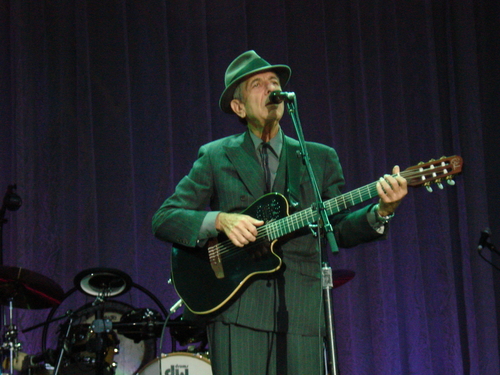
It is a joke you know Cohen has cracked a hundred times, the kind that makes my brother call him the Jewish Dean Martin. The humor is one part of a precise choreography, whose arrangements shift from blues to waltzes to New Orleans jazz, Celtic, gospel, country, and disco, all set in the mode of Hebrew Minor and conspiring to create a vivid world that does not exist, except in paradox. Honey is the texture that comes to mind. Viscous and turbid, neither solid nor liquid. Sensual relief from the coarse, metallic world. And sweet. Sweet in the meaning of the verse from the Persian song "Navaee"—"High sweet melody, and sadness of love, dwelling in the bottom of the heart, where nobody sees"—the mixing of sorrow and transcendence into sublime paradox.
He is and has been many things to his devotees: poet, singer, writer, band leader, lover, satirist, artist, and novelist. But one thing Leonard Cohen is not is a preacher.
Prostrating and posing on bended knee, eyes knit tight, hat pulled low—he could say anything he pleases, from treatises to treason, and people would listen. Given a room and a crowd, the born preachers cannot tame the urge to climb atop the pulpit. This political instinct to prophesy and govern is noted but subdued in the opening song of Old Ideas, called "Going Home," the cry of an old man liberated from burdens of desire for love and for mission: "He will speak these words of wisdom / like a sage, a man of vision / though he knows he's really nothing / but the brief elaboration of a tube ... a lazy bastard living in a suit."
Although he is no preacher, to say that the poems of Leonard Cohen have a liturgical quality is no stretch. He has played with Jewish canonical formulas for decades. "Who by Fire" revises one of the central liturgical themes of the autumnal atonement festivals (Rosh Hashana and Yom Kippur). "If It Be Your Will" uses a call-and-response technique through which priests and prayer-leaders communicate with congregants during worship.
But more than any mimicry of liturgical methods, there is a theological consistency in the language that evokes an essential tension guiding the approach Hebrew liturgy uses to converse with God. I like to watch the faces and postures of people at a Leonard Cohen concert: This one has her hands folded beneath her chin, that one his eyes closed in reverie, others are rocking their shoulders back and forth—shucklers, petitioners, prostrators, mumblers, and practitioners crooning in naked prayer.
Few words are more degraded and deadening than "prayer." There is something uniquely uncool about it. No New York publishing house would be excited by an author submitting a book of prayers. The word and the actions it represents seem static and boring. Hebrew liturgy, however, has no single term for prayer: The varieties of prayer are countless and constantly evolving because any utterance performed with the right approach can become prayer, if one is a "master of prayer."
The master of prayer ( baal tefillah in Hebrew) is nothing like the rabbinic preacher. Rabbis are controversial. They antagonize congregants, who find every which way to criticize the rabbi. The role of the master of prayer is to hold the community together. Since the objective of prayer is unitive, the master of prayer cannot be divisive. Individual prayer unites the soul and its seeker: communal prayer unites factions by annulling abstractions. The rabbi is a professional: equal parts lecturer, bureaucrat, adjudicator, and administrator; to every ruling there is opposition, every decision offends somebody. The master of prayer is an amateur. A populist. People want the rabbi to be above and better: more pious, reverent, disciplined, and wise. The master of prayer must be irreverent like everyone else, because if the master of prayer has the right to atone—and we know he's a sinner!—then I must also possess the right.
In the Rosh Hashana liturgy, this right is exercised by speaking truth, singing, trumpeting, bargaining, reminiscing, and even threatening to get angry with God—"Remember that time you made a covenant with Abraham / Don't you forget this deal / Or that it applies to me, no less than Abraham," the liturgy implores.
The most common misinterpretation of this liturgy is that we are petitioners, and God our absolute king and judge. But the approach is precisely the opposite: Dualism seems so real, but it is illusion. God is majestic and I am nothing, and yet God Majestic is crowned only at the pleasure of my participation. Since everything is God's creation, sin and suffering are neither separation nor exile: God forgives because in the end there is nothing to forgive. The game is rigged, but in my favor.
"We find ourselves / on different sides / of a line nobody drew," Cohen writes in a new song called "Different Sides." "Though it all may be one in the higher eye / Down here where we live it is two." And elsewhere on the album, the prayer "Come Healing" goes: "O, troubled dust concealing / An undivided love / The heart beneath is teaching / To the broken heart above."
Still, the master of prayer, despite knowing he possesses the right, approaches the throne of God humbly, just "a lazy bastard living in a suit," as Cohen puts it. "Here I am," is the opening line introducing the atonement ceremonies of Rosh Hashana and Yom Kippur. "I am here even though I am not worthy of offering this prayer."
This posture of the humble supplicant—"the brief elaboration of a tube"—is rooted in the ecclesiastical concept of vanity (in Hebrew hevel), which refers not to meaninglessness, as it often translated, but transience. "What are we? What are our lives ... When really there is no difference between a human being and an animal, because everything is vanity" (Ecclesiastes 3:19).
Ecclesiastical humility is the foundation of Hebrew canonical prayer, yet it is set directly alongside the boldest of spiritual concepts. "What gives me authority to stand here and ask for compassion?" the "Here I am" prayer asks in its conclusion. "Nothing, except that masters of prayer are angels, carrying prayers to the throne of God." The paradoxical merging of these two postures—ecclesiastical and angelic—creates the experience of majesty, of holiness, by entangling the worminess of inhabiting the body with the audacity to offer the highest prayer.
Among the varieties of prayer, this paradoxical prayer is the most demanding to perform. It stretches the imagination farthest, pushes the voice hardest. One must be absolutely sincere, or the whole effort disintegrates, and instead of honey the product is sap. When executed exquisitely, however, it makes angels and unrepentant sinners of everybody present. "You'd sing too," Cohen writes in his 2006 collection of poems, Book of Longing. "You wouldn't worry about / whether you were as good / as Ray Charles or Edith Piaf / You'd sing / You'd sing / not for yourself / but to make a self."
I don't mean to suggest that Leonard Cohen ought to be viewed only as a Jewish liturgist. How artificial and trivial this sounds! Anyway, you never know for certain when he is singing to the women of his life and when he is singing to God. Yet it's hard not to recognize the humble qualities of a master of prayer, who, when attempting to summon the nerve to sing, can do no more than close his eyes, grab hold of something firm, and hope to hell his voice doesn't crack.
Shefa Siegel, from Vancouver, British Columbia, writes about environment, ethics, and religion. His essays appear inHaaretz, Ethics & International Affairs, Americas Quarterly, and Yale Environment 360.


