Sunday, February 24, 2013

Leonard Cohen As Irreverent Master of Prayer


Can You Hear My Song? Leonard Cohen as Irreverent Master of Prayer
By Shefa Siegel
March 2013, Sojourners Magazine

IF YOU ARE not overly familiar with the repertoire of a Leonard Cohen concert, it's hard to tell the new songs from the old. Songs from a different age sound neither anachronistic nor nostalgic, while the new echo as though they have been around forever. It's the same show night after night, with songs from the latest album, Old Ideas (released in 2012), woven into the familiar canon. Cohen tells audiences that his revivalist tour might end in two years, so that he can start smoking again by the time he turns 80.
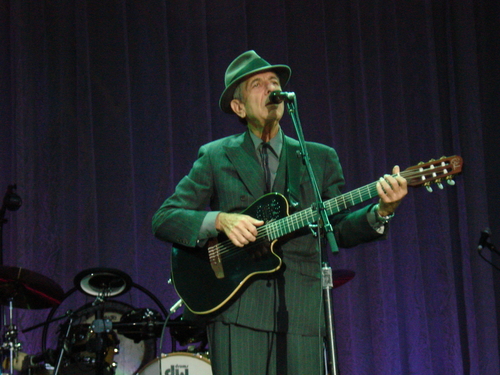


    It is a joke you know Cohen has cracked a hundred times, the kind that makes my brother call him the Jewish Dean Martin. The humor is one part of a precise choreography, whose arrangements shift from blues to waltzes to New Orleans jazz, Celtic, gospel, country, and disco, all set in the mode of Hebrew Minor and conspiring to create a vivid world that does not exist, except in paradox. Honey is the texture that comes to mind. Viscous and turbid, neither solid nor liquid. Sensual relief from the coarse, metallic world. And sweet. Sweet in the meaning of the verse from the Persian song "Navaee"—"High sweet melody, and sadness of love, dwelling in the bottom of the heart, where nobody sees"—the mixing of sorrow and transcendence into sublime paradox.
    He is and has been many things to his devotees: poet, singer, writer, band leader, lover, satirist, artist, and novelist. But one thing Leonard Cohen is not is a preacher.
    Prostrating and posing on bended knee, eyes knit tight, hat pulled low—he could say anything he pleases, from treatises to treason, and people would listen. Given a room and a crowd, the born preachers cannot tame the urge to climb atop the pulpit. This political instinct to prophesy and govern is noted but subdued in the opening song of Old Ideas, called "Going Home," the cry of an old man liberated from burdens of desire for love and for mission: "He will speak these words of wisdom / like a sage, a man of vision / though he knows he's really nothing / but the brief elaboration of a tube ... a lazy bastard living in a suit."
    Although he is no preacher, to say that the poems of Leonard Cohen have a liturgical quality is no stretch. He has played with Jewish canonical formulas for decades. "Who by Fire" revises one of the central liturgical themes of the autumnal atonement festivals (Rosh Hashana and Yom Kippur). "If It Be Your Will" uses a call-and-response technique through which priests and prayer-leaders communicate with congregants during worship.
    But more than any mimicry of liturgical methods, there is a theological consistency in the language that evokes an essential tension guiding the approach Hebrew liturgy uses to converse with God. I like to watch the faces and postures of people at a Leonard Cohen concert: This one has her hands folded beneath her chin, that one his eyes closed in reverie, others are rocking their shoulders back and forth—shucklers, petitioners, prostrators, mumblers, and practitioners crooning in naked prayer.
    Few words are more degraded and deadening than "prayer." There is something uniquely uncool about it. No New York publishing house would be excited by an author submitting a book of prayers. The word and the actions it represents seem static and boring. Hebrew liturgy, however, has no single term for prayer: The varieties of prayer are countless and constantly evolving because any utterance performed with the right approach can become prayer, if one is a "master of prayer."
    The master of prayer ( baal tefillah in Hebrew) is nothing like the rabbinic preacher. Rabbis are controversial. They antagonize congregants, who find every which way to criticize the rabbi. The role of the master of prayer is to hold the community together. Since the objective of prayer is unitive, the master of prayer cannot be divisive. Individual prayer unites the soul and its seeker: communal prayer unites factions by annulling abstractions. The rabbi is a professional: equal parts lecturer, bureaucrat, adjudicator, and administrator; to every ruling there is opposition, every decision offends somebody. The master of prayer is an amateur. A populist. People want the rabbi to be above and better: more pious, reverent, disciplined, and wise. The master of prayer must be irreverent like everyone else, because if the master of prayer has the right to atone—and we know he's a sinner!—then I must also possess the right.
    In the Rosh Hashana liturgy, this right is exercised by speaking truth, singing, trumpeting, bargaining, reminiscing, and even threatening to get angry with God—"Remember that time you made a covenant with Abraham / Don't you forget this deal / Or that it applies to me, no less than Abraham," the liturgy implores.
    The most common misinterpretation of this liturgy is that we are petitioners, and God our absolute king and judge. But the approach is precisely the opposite: Dualism seems so real, but it is illusion. God is majestic and I am nothing, and yet God Majestic is crowned only at the pleasure of my participation. Since everything is God's creation, sin and suffering are neither separation nor exile: God forgives because in the end there is nothing to forgive. The game is rigged, but in my favor.
    "We find ourselves / on different sides / of a line nobody drew," Cohen writes in a new song called "Different Sides." "Though it all may be one in the higher eye / Down here where we live it is two." And elsewhere on the album, the prayer "Come Healing" goes: "O, troubled dust concealing / An undivided love / The heart beneath is teaching / To the broken heart above."
    Still, the master of prayer, despite knowing he possesses the right, approaches the throne of God humbly, just "a lazy bastard living in a suit," as Cohen puts it. "Here I am," is the opening line introducing the atonement ceremonies of Rosh Hashana and Yom Kippur. "I am here even though I am not worthy of offering this prayer."
    This posture of the humble supplicant—"the brief elaboration of a tube"—is rooted in the ecclesiastical concept of vanity (in Hebrew hevel), which refers not to meaninglessness, as it often translated, but transience. "What are we? What are our lives ... When really there is no difference between a human being and an animal, because everything is vanity" (Ecclesiastes 3:19).
    Ecclesiastical humility is the foundation of Hebrew canonical prayer, yet it is set directly alongside the boldest of spiritual concepts. "What gives me authority to stand here and ask for compassion?" the "Here I am" prayer asks in its conclusion. "Nothing, except that masters of prayer are angels, carrying prayers to the throne of God." The paradoxical merging of these two postures—ecclesiastical and angelic—creates the experience of majesty, of holiness, by entangling the worminess of inhabiting the body with the audacity to offer the highest prayer.
    Among the varieties of prayer, this paradoxical prayer is the most demanding to perform. It stretches the imagination farthest, pushes the voice hardest. One must be absolutely sincere, or the whole effort disintegrates, and instead of honey the product is sap. When executed exquisitely, however, it makes angels and unrepentant sinners of everybody present. "You'd sing too," Cohen writes in his 2006 collection of poems, Book of Longing. "You wouldn't worry about / whether you were as good / as Ray Charles or Edith Piaf / You'd sing / You'd sing / not for yourself / but to make a self."
    I don't mean to suggest that Leonard Cohen ought to be viewed only as a Jewish liturgist. How artificial and trivial this sounds! Anyway, you never know for certain when he is singing to the women of his life and when he is singing to God. Yet it's hard not to recognize the humble qualities of a master of prayer, who, when attempting to summon the nerve to sing, can do no more than close his eyes, grab hold of something firm, and hope to hell his voice doesn't crack.
    Shefa Siegel, from Vancouver, British Columbia, writes about environment, ethics, and religion. His essays appear inHaaretz, Ethics & International Affairs, Americas Quarterly, and Yale Environment 360.

    Sunday, February 3, 2013

    The Orphans of God


    By Mark Heard
    From Satellite Sky
    I will rise from my bed with a question again 

    As I work to inherit the restless wind 

    The view from my window is cold and obscene
    I want to touch what my eyes haven't seen
    But they have packaged our virtue in cellulose dreams 

    And sold us the remnants 'til our pockets are clean 

    ‘Til our hopes fall 'round our feet like the dust and dead leaves
    And we end up looking like what we believe
    We are soot-covered urchins running wild and unshod 

    We will always be remembered as the orphans of God 

    They will dig up these ruins and make flutes of our bones 

    And blow a hymn to the memory of the orphans of God
    Like bees in a bottle we are flying at fate 

    Beating our wings against the walls of this place 

    Unaware that the struggle is the blood of the proof
    
In choosing to believe the unbelievable truth
    But they have captured our siblings and rendered them mute 

    They've disputed our lineage and poisoned our roots 

    We have bought from the brokers who have broken their oaths
    
And we're out on the streets with a lump in our throats
    We are soot-covered urchins running wild and unshod 

    We will always be remembered as the orphans of God 

    They will dig up these ruins 
and make flutes of our bones 

    And blow a hymn to the memory of the orphans of God

    http://www.youtube.com/watch?v=N58edukzT8c

    Sunday, January 27, 2013

    The Requirement of Riches


    Craig Groeschel with some wise counsel reprinted from the May/June 2011 issue of Relevant Magazine.


    I am going to read your mind. Think: How much money would you need to feel you were “rich”? Envision a specific dollar amount. Whether your number is an annual income range or a fixed dollar figure, the number you came up with is … more than what you currently make or have. How did I know? Because you’re normal.
    Gallup asked Americans what annual income they’d need to consider themselves rich. People who made $30,000 a year or less answered (on average) $74,000 a year. People who made around $50,000 a year said they’d need $100,000 a year to be rich. Virtually no one believed their existing annual income Perspective classified them as rich. It’s not surprising, really. Ecclesiastes 5:10 tells us, “Whoever loves money never has enough; whoever loves wealth is never satisfied with their income” (NIV).
    When normal people picture someone rich, they imagine a hedge fund tycoon, a successful entrepreneur or that average-looking person in high school they never dated who grew up, turned gorgeous and wrote a best-selling novel. It’s always someone else who’s rich, not you. Rich people rarely think they’re rich—because someone else, somewhere, has more.
    Most of us place ourselves financially somewhere between a millionaire and a homeless person. But there’s a problem with this completely normal line of thinking. Normal people, even when we sincerely seek to follow God, often skim past the parts of the Bible directed at rich people, thinking, “Oh, that’s for somebody else.”
    If you haven’t missed a meal in the last three weeks—because you couldn’t afford it, not because you were dieting—you’re rich. If your kids attend a school of your choosing—either because you pay for it or because you’ve chosen to live in a specific geographic area—you’re rich. Do you have a car? Only 3 to 5 percent of people in the world do, you know. Rich people. If you have a little house for your car (often called a “garage”), you’re rich. If you pay other people to prepare and serve you food—like, say, in a restaurant—you’re rich. While you may not feel rich, the fact is, you are, because you have rich-people opportunities.
    Luke 12:48 says, “From everyone who has been given much, much will be demanded; and from the one who has been entrusted with much, much more will be asked.” God has blessed you with enough—actually, with more than enough—because He is entrusting you with a great responsibility. But that responsibility comes with a wonderful promise: Proverbs 22:9 says, “The generous will themselves be blessed” (NKJV).
    I know business leaders who have an eye for deals. I know good designers who have an eye for color. But cultivating a generous eye requires no innate gifts—only practice. What does the world start to look like when we begin to perceive it through generous eyes? When we focus on giving what we can, where we can, we begin seeing others the way God sees them: as people in need.
    If we want blessings that last, we need to look beyond materialism. First John 2:15 and 17 tell us: “Do not love the world or anything in the world. … The world and its desires pass away, but whoever does the will of God lives forever.” What things do you desire? Financial experts say you can see where your passions are just by looking at your checking account history. Where you’re spending shows what things you truly care about.
    So, we know what we should do. But how do we do it? Jesus answers in Luke 12:22-34, and in verse 34 specifically: “Where your treasure is, there your heart will be also.” But this principle can work in reverse, too. Where do you want your heart to go? Then start putting the things you value there—and your heart will follow.
    As I hinted at earlier, the only way to cultivate generous eyes is to practice—to look for opportunities and then give in to them. I like to think of these as three levels of giving:
    1. Spontaneous. When you see a need you can meet, do it.


    2. Strategic. Plan your giving. Calculate ways your generosity can achieve maximum impact.


    3. Sacrificial. Live like you’re managing not your own resources, but God’s. Give both spontaneously and strategically, but use only the minimum that you need and give the rest.


    Practicing all three will not only draw you closer to God, but it will help you begin to see life from His eternal perspective. When people say, “I don’t have enough to give,” what they’re truly saying is they don’t feel they have enough extra to give without adjusting their lifestyle. It takes deliberate intention and time to develop generous eyes. God has blessed you so that you can be a blessing to others. It’s time to let God transform your intentions into actions.

    Sunday, January 20, 2013

    "Goodness has never been a guarantee of safety," and more Madelein L'Engle quotes (Part 2)


    Madelein L’Engle (1918-2007) authored over 40 books, including A Wrinkle In Time and all of its sequels.  I still recall my 3rd grade teacher reading those to us, and being mesmerized by the way they stimulated my imagination.  Her writing reflected her deep Christian faith, a love of science, and a curiosity to ask many questions. I was privileged to hear her give the Commencement Address to my graduating class at Wheaton College in 1977.  Here is Part 2 of my favorite quotes from her writings.  Let me know which ones resonate with you.


    Because it is the nature of love to create, a marriage itself is something which has to be created, so that, together we become a new creature.

    The growth of love is not a straight line, but a series of hills and valleys.

    Anger is not bitterness. Bitterness can go on eating at a man's heart and mind forever. Anger spends itself in its own time.

    The world of science lives fairly comfortably with paradox. We know that light is a wave, and also that light is a particle. The discoveries made in the infinitely small world of particle physics indicate randomness and chance, and I do not find it any more difficult to live with the paradox of a universe of randomness and chance and a universe of pattern and purpose than I do with light as a wave and light as a particle. Living with contradiction is nothing new to the human being.

    Like it or not, we either add to the darkness of indifference and out-and-out evil which surrounds us or we light a candle to see by.

    And there's no getting around the fact that all life lives at the expense of another life.

    You and I have good enough minds to know how very limited and finite they really are. The naked intellect is an extraordinarily inaccurate instrument.

    There is in God, some say, a deep but dazzling darkness.

    It was the same way with silence. This was more than silence. A deaf person can feel vibrations. Here there was nothing to feel.

    We have much to be judged on when he comes, slums and battlefields and insane asylums, but these are the symptoms of our illness and the result of our failures in love.

    Goodness has never been a guarantee of safety.

    One of the most pusillanimous things we of the female sex have done throughout the centuries is to have allowed the male sex to assume that mankind is masculine. It is not. It takes both male and female to make the image of God. The proper understanding of mankind is that it is only a poor, broken thing if either male or female is excluded.

    The joys of love...last only a moment. The sorrows of love last all the life long.

    My dear, I'm seldom sure of anything. Life at best is a precarious business, and we aren't told that difficult or painful things won't happen, just that it matters. It matters not just to us but to the entire universe.

    God promised to make you free. He never promised to make you independent.

    Why does anybody tell a story? It does indeed have something to do with faith. Faith that the universe has meaning, that our little human lives are not irrelevant, that what we choose or say or do matters, matters cosmically.

    If you're too happy about anything, fate usually gives you a good sock in the jaw and knocks you down.

    I am not some kind of computer. Only machines have glib answers for everything.

    The peculiar idea that bigger is better has been around for at least as long as I have, and it's always bothered me. There is within it the implication that it is more difficult for God to care about a gnat than about a galaxy. Creation is just as visible in a grain of sand as in a skyful of stars. The church is not immune from the bigger-is-better heresy. One woman told of going to a meeting where only a handful of people turned out, and these faithful few were scolded by the visiting preacher for the sparseness of the congregation. And she said indignantly, 'Our Lord said *feed* my sheep, not count them!' I often feel that I'm being counted, rather than fed, and so I am hungry.
      
    No! Alike and equal are not the same thing at all!”

    If we don't pray according to the needs of the heart, we repress our deepest longings. Our prayers may not be rational, and we may be quite aware of that, but if we repress our needs, then those unsaid prayers will fester.

    You're going to get hurt yourself, and badly, if you take everything so hard.

    She began to feel the sense of wonderful elation that always came to her when beauty took hold of her and made her forget her fears.

    Love isn't how you feel. It's what you do.

    Two people whose opinion I respect told me that the word "Christian" would turn people off. This certainly says something about the state of Christianity today. I wouldn't mind if to be a Christian were accepted as being the dangerous thing which it is; I wouldn't mind if, when a group of Christians meet for bread and wine, we might well be interrupted and jailed for subversive activities; I wouldn't mind if, once again, we were being thrown to the lions. I do mind, desperately, that the word "Christian" means for so many people smugness, and piosity, and holier-than-thouness. Who today can recognize a Christian because of "how those Christians love one another"?”

    It does not matter that we cannot fathom this mystery. The only real problem comes when we think that we have.

    If we accept that we have at least an iota of free will, we cannot throw it back the moment things go wrong. Like a human parent, God will help us when we ask for help, but in a way that will make us more mature, more real, not in a way that will diminish us.

    You cannot see the past that did not happen any more than you can foresee the future.

    But grief still has to be worked through. It is like walking through water. Sometimes there are little waves lapping about my feet. Sometimes there is an enormous breaker that knocks me down. Sometimes there is a sudden and fierce squall. But I know that many waters cannot quench love, neither can the floods drown it.

    Compassion is nothing one feels with the intellect alone. Compassion is particular; it is never general.

    Life is not easy and comfortable, with nothing ever going wrong as long as you buy the right product. It's not true that if you have the right insurance everything is going to be fine. That's not what it's really like. Terrible things happen. And those are the things we learn from.

    We human beings grow through our failures, not our virtues.

    No wonder our youth is confused and in pain; they long for God, for the transcendent, and they are offered, far too often, either piosity or sociology, neither of which meets their needs, and they are introduced to churches which have become buildings that are a safe place to go to escape the awful demands of God.

    Alas. What have we done to our good, bawdy, Anglo-Saxon four-letter words? ...We have blunted them so with overuse that they no longer have any real meaning for us. ...When will we be able to redeem our shock words? They have been turned to marshmallows. ...We no longer have anything to cry in time of crisis. 'Help!' we bleat. And no one hears us. 'Help' is another of those four-letter words that don't mean anything any more.

    How do I make more than a fumbling attempt to explain that faith is not legislated, that it is not a small box which works twenty-four hours a day? If I 'believe' for two minutes once every month or so, I'm doing well.

    Thoughts?


    Wednesday, January 16, 2013

    My Quarrytorium Moratorium...A Hockey Hiatus for the Next Four Months


    Many of my friends will find this hard to believe, but I just cancelled my season ticket for the Nashville Predators.  This might seem especially odd in that the 133 day lockout over a new Collective Bargaining Agreement (CBA) between the National Hockey League and the players’ union has just been resolved, and the shortened regular season is about to finally commence. 

    It takes a lot to shake the hockey out of my system. Even before the NHL’s arrival, I had seen hundreds of major and minor league games across the country, and wrote a monthly column on pro hockey marketing in a national publication for years.  As a member of Mayor Phil Bredesen’s civic committee to research and recommend a downtown arena, I was one of the few that lobbied hard for the facility to be fitted for ice hockey.  Other cam around to realizing that the NHL was a much better possibility for an expansion or relocated franchise than the NBA.

    As some of you may know, I’ve been a staunch supporter of the Preds as a season ticket holder since Day 1 in 1998.  In the first ten seasons, I only missed six games. I was on a first name basis friendship with then-owner Craig Leipold and attended countless fan relation and marketing meetings. I interacted regularly with many in the front office.  Along with a few other knuckleheads, I helped create the fan experience known as Cellblock 303 that helped generate an energy at Preds’ games like none other in the league.  My vocal histrionics and enthusiasm at the rink watching the Predators encircle their quarry…their prey, have earned me the monikers of “The Warden,” “The Duke of Rebuke,” and, most aptly, “Chief Goofball.” Heck, I was even at Bridgestone a day and a half after heart surgery yelling my head off for the Predators’ Game 5 clincher over the hated Red Wings in Round One of the Stanley Cup Playoffs last April. There has been little to compare with the fun and pride of watching this young team develop into strong contenders. So, it is clear that my loyalty to the Preds has been unwavering.

    When the last lockout occurred, which wiped out the entire 2004-2005 season (a first for any major pro league in US sports history), I kept my money invested in my tickets.  Like most fans, we realized that impasse was necessary for the well being of the league’s future.  Exorbitant salaries, lack of a salary cap, no profit sharing, etc. needed to be addressed or the whole system would implode.  In the next seven seasons, due to the positive changes that were implemented, the NHL’s revenue’s tripled to $3 billion, even in the face of the big recession. You would think that unprecedented growth would mean that when the current contract came to a close this past September that there would just need to be a few minor tweaks to the next CBA and the league could continue its upward trajectory.

    But no…greed reared its ugly head on both the owners and players union sides, and there were no reasonable compromises brought to bear on how these multi-millionaires were going to split $3,000,000,000. Hence, another lengthy shutdown.  All the record-breaking growth of the Predators from last season, including a new record of 25 sellouts, swelling corporate partnerships, and the highest TV ratings in their history were put in jeopardy.  Not to mention all the restaurateurs, parking enterprises, and arena employees whose livelihoods were threatened with all the cancelled games.

    So, it is not without considerable consternation and sadness that I’ve made this decision.  I certainly don’t want to see the Predators franchise fail, but SOMEBODY needs to get the message that these selfish work stoppages are unacceptable, especially to we fans who fill those millionaires coffers.  And maybe it is just ME that needs to be reminded of this.  When I weigh everything out, I still can’t get past the ungratefulness of the union and the owners.  Nor can I stomach their presumption that we will blindly return no matter what.

    I know of other season ticket holders who are willing to move forward, and I refuse to be critical of anyone else’s reasoning.  If they are at peace with their decision, that is fine by me.  My frustration is not with my fellow fans.

    But I feel I need to make this statement.  Perhaps I’ll have a change of heart once the regular season is complete. Or maybe it will be late in the summer before I’m ready.  Or perhaps never.

    My hope is that the league sees a significant drop in attendance and revenues this season.  Maybe a franchise or two closes shop due to significant downturns.  Then, perhaps, some vows will be made by the powers-that-be to NEVER put the fans through this again (I can dream, can’t I?).

    No doubt I will pine-away some evenings for the adrenaline rush of a spirited contest against the Dead Things, Blackholes, or Blosers.  Going to a Predators’ game is a form of Primal Scream Therapy where I can pour it out in a way that is good for my constitution.  But more than anything, I will miss the camaraderie of all my fellow inmates in the Cellblock, and the rest of the NBP (North Balcony Posse).  I hope to see you all again…and please don’t hold this against me.

    When I receive my refund from the Preds for my season ticket, I’m signing it over to the Nashville Rescue Mission.  Now there’s a downtown institution that’s been staying open day in and day out for decades and actually doing what they’re supposed to be doing.